2 DE ABRIL DE 2024
DÍA MUNDIAL DEL AUTISMO:
LA VOZ DE GALICIA, 3 DE ABRIL DE 2024
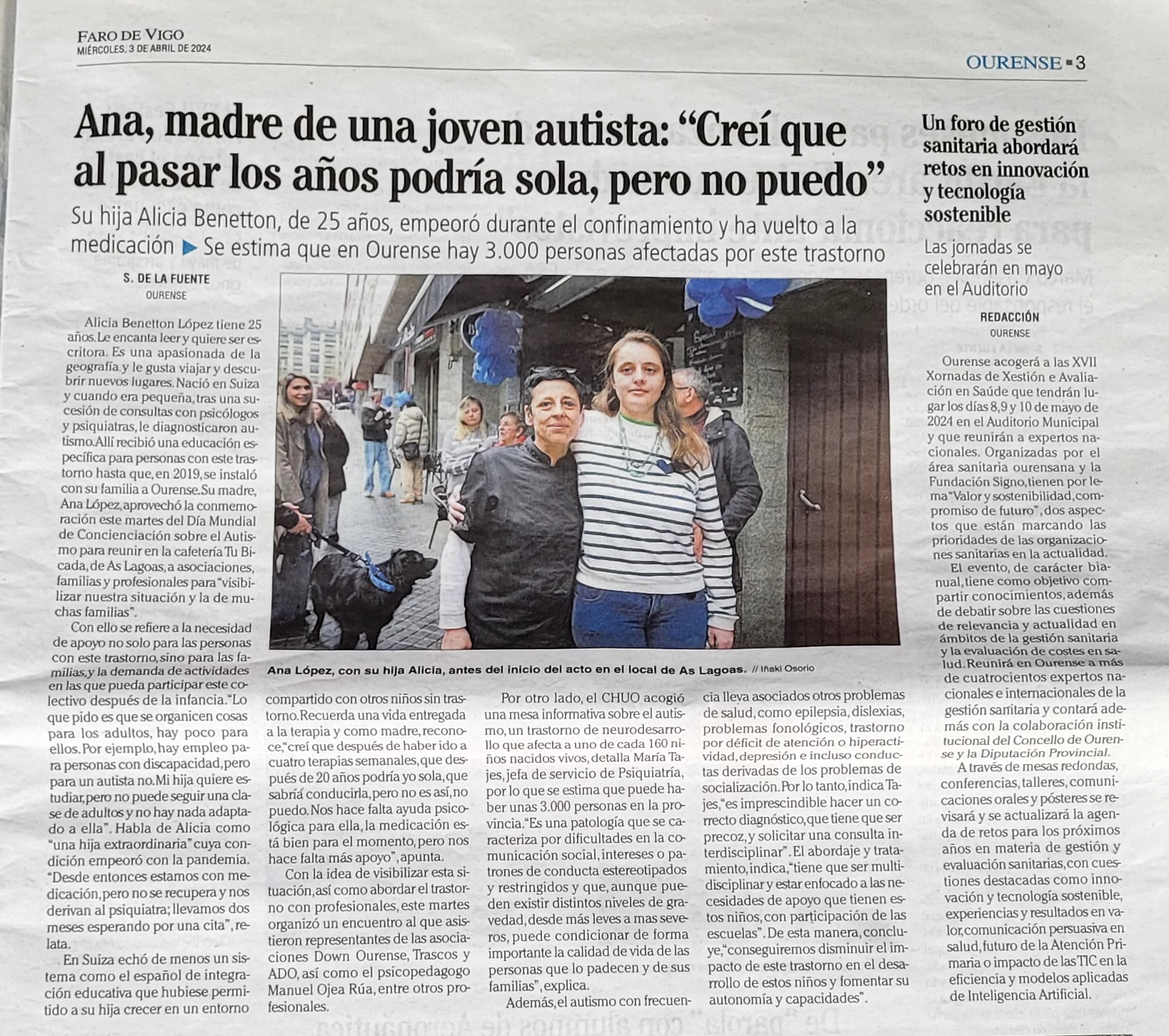
El prof. Manuel Ojea Rúa expone las últimas investigaciones científicas relacionadas con el trastorno del espectro autista:
Manuel Ojea Rúa es Catedrático de Orientación Educativa (3492563057A0511). Doctor en Psicología- Pedagogía por la Universidad de Vigo. Especialista en Neuropsicología del Desarrollo. Psicólogo colegiado con el nº GX05862. Instituto Social de Investigación en Autismo (G44568509), situado en la Universidad de Vigo. Es autor de 57 libros, 216 Artículos en Revistas Científícas y numerosos Articulos en Prensa. https://orcid.org/my-orcid?orcid=0000-0002-9787-2520. mail: moxea@uvigo.es
El prof. Manuel Ojea Rúa expone las últimas investigaciones científicas relacionadas con el trastorno del espectro autista:
Prof. Dr. Manuel Ojea Rúa
Ver vídeo explicativo:
En la compañía de familias y profesionales de la psicología, la educación y la medicina:
The diagnostic conclusions were based on the gaussian curve found from the typical scores obtained from the direct scores obtained in the ten dimensions of the analysis, made up of three dimensional categories, whose percentage weighting is as follows: 1) the procedural category (60%), 2) the social dimensional category (20%), and 3) the behavioural dimensional category (20%), the overall sum of which allows the diagnostic conclusions of the disorder to be drawn, both at a general level and according to the specific level of ASD. The percentage levels are justified by the empirical studies of the study. Thus, the stepwise linear regression analysis carried out includes two dimensions corresponding to the procedural category as basic predictors of the disorder: I) semantic retrieval (Beta: .90, R2: .82), and II) relationship between retrieval (Beta: .57) and interconcepts or relationships (R2: .82). 57) and interconcepts or relationships between information (Beta: .35), being the overall constant (Beta: .92, R2: .84), ahead of the social or behavioural dimensions, which supports the importance of the procedural dimension, especially related to the development of nodes or relationships between information content in determining the specific criteria for the diagnosis of ASD.
The teaching and learning of students with Autism Spectrum Disorder (ASD) requires the design of diversity projects at the different institutional levels of the educational centre. However, if these projects are not well adapted to the specific needs of the students, they will not achieve the expected effective results. In a study conducted with a total of 145 participants from different schools, it was shown that the presence of specific institutional educational projects was not a sufficient condition to respond effectively to the needs of the participants, whose curricular and social improvements were not shown to be significant (sig: .66). Even in the absence of these high-scale projects, when the usual methodology was well adapted to the specific needs of students with ASD, the improvements found in the academic and social, that´s coded as dependent variable (DV): improving, domains were highly significant (sig: .00) in terms of the use of meaningful didactics based on the creation of networks of relationships between informative content or highly meaningful learning. Now, the interactive constant of both components, i.e. the intersection of a project design when these have been appropriately adapted to the particular needs, then both variables became the explanatory variance of the academic and social of DV of students with ASD (constant t for the sum of nodal relationships + project: 3.70 (sig: .00), to which was added the explanatory variance of the students' age intervals (constant t for the sum of nodal relationships + project + age: 4.07, sig: .00): 3.70 (sig: .00), to which was also added the explanatory variance of the students´age intervals (constant t for the sum of nodal relationships + project + age: 4.07, sig: .00). 70 (sig: .00), to which the explanatory variance of the students´ age intervals were also added (constant t for the sum of nodes + project + age: 4.07, sig: .00). In conclusion, the design of general institutional projects, even if they cover all levels of education, are not effective on their own unless they are specifically tailored to the particular needs of the target student’s variable: “improving”.
Autism spectrum disorder. Significant learning. Educational projects. Adapted regular teaching.
International Journal of Current Science Research and Review, Vol 9 No 4 (2026) , pp. 2177-2190 Comparative analysis of diagnosis and beh...